social share alt icon

THE POWER OF TRANSFORMATION


IN EDUCATION & LIVELIHOOD, INCLUSION, CONSERVATION, AND TECHNOLOGY

MPHASIS F1 FOUNDATION


We harness technology to make education accessible, provide digital upskilling for underserved communities, and prepare individuals for success in the evolving digital landscape. Inclusion has been a priority, with initiatives that empower PwDs through skill-building and inclusive employment. We are committed to environmental sustainability, promoting renewable energy, biodiversity protection and climate action. Through our ‘Tech for Good’ approach, we lead initiatives that use technology to drive social transformation and create meaningful change. The Mphasis F1 Foundation champions these efforts, working across sectors to build a more equitable and sustainable future for all.

CSR PILLARS


Tech-Enabled Social Mobility

Technology-led interventions that drive social mobility for underserved and underrepresented communities by improving access to education, skills, employment pathways, inclusion, and opportunity. This portfolio integrates developmental challenges with technology, data, and innovation to enable long-term socioeconomic progress.


Focus Areas :


  1. Social Advancement through Technology

    Enabling education, skills development, employability, and inclusion for women, youth, and Persons with Disabilities by bridging digital divides and expanding access to opportunities.

  2. Innovation, Entrepreneurship & Leadership Pathways

    Strengthening innovation-oriented thinking, creativity, problem-solving, and leadership. Supporting entrepreneurial pathways, solution development, and deep-tech capability building through university-led and community innovation ecosystems.

  3. Applied Research & Knowledge Development

    Supporting research-led solutions that use deep-tech, AI, data, and interdisciplinary methods to tackle social, developmental, and accessibility challenges at scale.
Environmental Sustainability

Community-centered and research-backed initiatives aimed at enhancing environmental resilience, conserving natural ecosystems, and accelerating climate action. This portfolio focuses on protecting ecological resources, building sustainable communities, and advancing climate innovation.


Focus Areas :


  1. Water Security & Ecosystem Restoration

    Enhancing the resilience of water systems and natural habitats through protection, regeneration, and sustainable management of shared community resources.

  2. Climate Resilience & Ecological Stewardship

    Supporting biodiversity, carbon sequestration, land restoration, and ecosystem-based climate solutions that benefit vulnerable populations and urban–rural communities.

  3. Green Innovation & Environmental Research

    Advancing scientific inquiry, climate technologies, and data-driven environmental solutions to support India’s sustainability goals and global climate commitments.
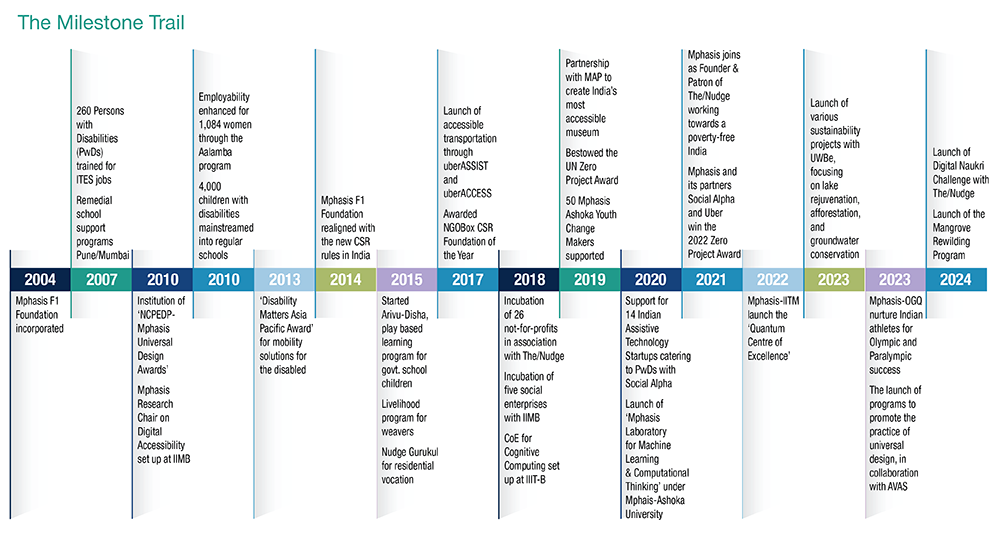
MPHASIS CSR JOURNEY


MPHASIS CSR IMPACT


CSR COMMITTEE AND THE TEAM


CSR PROGRAMS

Mphasis F1 Foundation delivers high-impact programs through two strategic portfolios. Each combines innovation, research, and community-focused interventions to create scalable and sustainable impact.


Tech-Enabled Social Mobility

This portfolio brings together education, skills, technology, inclusion, innovation, research, and leadership development to advance social mobility for underserved groups.


Programs Include:


  • Akanksha Foundation
    To create a scalable school model within the government system and to provide children of underserved communities the knowledge, skills, and values they need to lead empowered lives, maximize their potential and break out of the cycle of inter-generational poverty by building high-performing, innovative schools and strengthening public school systems Akanksha engages with children over a span of 20+ years – from the age of 4 to 25.

  • Mphasis AI & Robotics Lab – SHINE Foundation
    To create exponential value through collaboration between tech talent, regional innovators, and the business community. Located within Sahyadri’s Centre for Future Leaders, the 4,000 sq. ft. lab will focus on developing impactful solutions using cutting-edge technologies such as Agential AI, Cloud Computing, Robotics, Computer Vision, Edge AI, IIoT, Embedded Solutions, Digital Printing, Metaverse, and Web 3.0 applications.

  • CEQUE
    To transform classroom teaching for measurable improvements in student learning in government and low-income private schools. Through its Teacher Innovator Program, CEQUE has coached over 550 teachers across 400 schools in Maharashtra over the past eight years, impacting more than 11,000 children. The organization also mentors school leaders in academic leadership and produces high-quality, open-source videos of innovative lesson ideas filmed in real classrooms.

  • IIT Madras
    Establised Mphasis Centre for Quantum Information, Communication and Computing (MCQuICC). The field of “Quantum Technology” is one of the cutting-edge research areas that IITM seeks to explore and this has led to the birth of our new Center for Quantum Information, Communication and Computing. The Center is set up with an objective of developing various facets of various applications of quantum technologies in the area of secure quantum communications, including quantum key delivery, quantum random number generation, quantum sensing and metrology, as well as quantum computing-related innovations.

  • Ashoka University
    The Mphasis AI & Applied Tech Lab at Ashoka is a distinguished collaboration between Ashoka University and Mphasis, exemplifying the synergy of industry and academia. The lab prides itself on its interdisciplinary approach, bridging various academic realms to offer a holistic perspective on computational challenges. With students and researchers hailing from diverse disciplines, the lab ensures computational learning remains accessible and impactful. This inclusive approach not only promotes diversity of thought but also encourages students and researchers to fuse their expertise, leading to groundbreaking solutions.

  • Plaksha University
    The center aims to create an inclusive and thriving ecosystem that facilitates advancement of girls and women in STEM (Science, Technology, Engineering & Mathematics) endeavors. Empowering 300+ women students for corporate careers through skill-building, mentorship, and role models, while engaging 1000+ students through mentoring walks, hackathons, webinars, and GWiST events.

  • Indian Institute of Science, Bangalore (IISc)
    The Mphasis Lab at the Centre for Society and Policy (CSP), Indian Institute of Science, Bangalore aims to address the issues of sustainability and financial inclusion to mitigate systemic risks and reduce the economic shocks experienced by economically vulnerable populations and to accelerate the transition towards a more sustainable economy.

  • Mphasis e-Pathshala - Navsrishti
    Mphasis ePathshala is a scalable model that empowers students, supports teachers, and complements the Government’s vision for technology-enabled education. The initiative covers setting up 20 ePathshalas (Smart Classes) in Govt schools in Mangaluru, each equipped with: - 65” Interactive Flat Panels (IFPs) - Curriculum-aligned digital content (Grades 1–10) - Teacher training in digital pedagogy.


  • Training and Educational Centre for Hearing Impaired (TEACH)
    To provide comprehensive educational and training programs, including higher education, skills development, and language courses, along with a structured graduation pathway that equips Deaf and Hard of Hearing students with the knowledge and skills needed for self-sufficiency, independence, and successful employment opportunities.

  • EU-India Ideathon - BCKIC
    To foster collaboration between EU and Indian participants, combining expertise from academia, startups, businesses, and policymakers to tackle marine plastic pollution—a crisis affecting marine ecosystems, human health, and coastal economies. The Ideathon encourages impactful innovation and strengthens ties between the EU and India in environmental sustainability.

  • Indian Institute of Technology, Bombay
    IIT Bombay’s TRUST Lab aims to establish a national nucleus for privacy-enhanced fintech security by converging AI-enabled cybersecurity, quantum cryptography, and digital infrastructure security. It will promote research and innovation in areas of societal and national relevance, address emerging challenges such as cybersecurity, advance structured skilling through academic cohorts and training programs, and facilitate interdisciplinary projects that deliver sustainable social impact.

  • National Centre for Promotion of Employment for Disabled People (NCPEDP)
    Continuing the prestigious NCPEDP-Mphasis Universal Design Awards that are given every year on the eve of Independence Day of India to honor individuals and organizations doing exemplary work towards the cause of accessibility and thus ensuring a life of equality and dignity for persons with disabilities.

  • The/Nudge Institute
    The Incubator and Accelerator Program nurtures social entrepreneurs working on disruptive models for resilient livelihoods at scale through innovation grants, mentoring, and ecosystem connects. The Indian Administrative Fellowship engages senior executives to drive strategic government programs, influencing ₹500+ crore in funds and impacting millions through policy and process optimization. The/Nudge Prize fosters population-scale solutions for livelihood challenges, with the upcoming 2024 challenge focusing on the ‘Future of Women in Work,’ inviting 30–50 organizations to compete for the grand prize.

  • National Centre for Promotion of Employment for Disabled People (NCPEDP) AT Hub
    Partnered to establish Center of Excellence and entrepreneurship for research and innovation, building AT evidence base, making policy interventions, among others. The program drives assistive technology adoption through five key areas: supporting startups with seed funding, mentorship, and market access; building infrastructure via hubs and cluster institutions; shaping policy and standards with government and industry partners; raising awareness through campaigns and public engagement; and improving access by collaborating with DPOs and industry to make essential products like wheelchairs, hearing aids, and crutches more affordable and widely available.

  • OGQ
    To prepare Para Athletes for the LA 2028 Paralympics by training and supporting athletes with world class training and provide opportunity to develop their skills, and the ability to adapt to various playing styles as they compete in Paralympics. The mission of OGQ is to support Indian athletes in winning Olympic and Paralympic Gold medals. In the last four Olympics, 13 out of the 21 medal winners for India were supported by OGQ and 35 out of the 48 medals for India at the Tokyo 2020 & Paris 2024 Paralympics were supported by OGQ.

  • Museum of Art and Photography (MAP)
    To support technology-driven immersive art experiences at MAP to enhance visitor engagement, promote education and inclusivity, showcase innovation, and reach diverse audiences. The museum is committed to making art and heritage accessible to diverse audiences and fostering a culture of museum-going that encourages people to experience these in new ways. Its services are designed to create opportunities for members by enabling them to meet, exchange ideas, learn, and discover new prospects within a trusted network.


Environmental Sustainability

This portfolio consolidates all nature, climate, water, and ecosystem-focused programs under a unified environmental strategy.


Programs Include:


  • Mangroves Rewilding
    To support the restoration of mangrove forests and associated flora along the Kosasthalyar River, Buckingham Canal, and Pulicat Lake, covering 70 acres.

  • One Billion Drops
    Conserve 153 million liters of rainwater by 2026 through 1,200 percolation wells, aiming to restore depleting groundwater levels around Bengaluru.

IMPACT REPORTS

In an attempt to understand and evaluate the broader benefits and effectiveness of CSR projects as experienced by the stakeholders, third-party impact assessments are carried out annually. Through these studies and reports, we are able to evaluate the progress made in F1 Foundation’s areas of focus and identify new areas of growth. The CSR impact assessment methodology followed in these studies complies to The Companies (CSR Policy) Amendment Rules 2021 and The Companies Act 2013.


  • United Way-Bengaluru - Response to Gaja Cyclone
  • Indian Institute of Management Bangalore(IIMB)- Mphasis Research Chair on Digital Accessibility
  • United Way of Bengaluru-Setup of STP and Lake Rejuvenation at Mahadevapura Lake
  • International Institute of information Technology Bangalore- Mphasis IIITB Centre of Excellence for Cognitive Computing
  • The/Nudge Center for Social Innovation Support to Non-profit Start-up Incubation Program
  • National Centre for Promotion of Employment for Disabled People (NCPEDP) - Promoting Easy Access for Persons with Disabilities
  • Foundation for Innovation and Social Entrepreneurship (Social Alpha) - Incubation and acceleration of social enterprises in assistive tech
  • IIM-B NSRCEL (NS Raghavan Centre for Entrepreneurial Leaning) - Incubation and acceleration of social enterprises
  • Digital Empowerment Foundation - Digital empowerment for rural artisans in Musiri, Trichy

PARTNERS VIDEOS